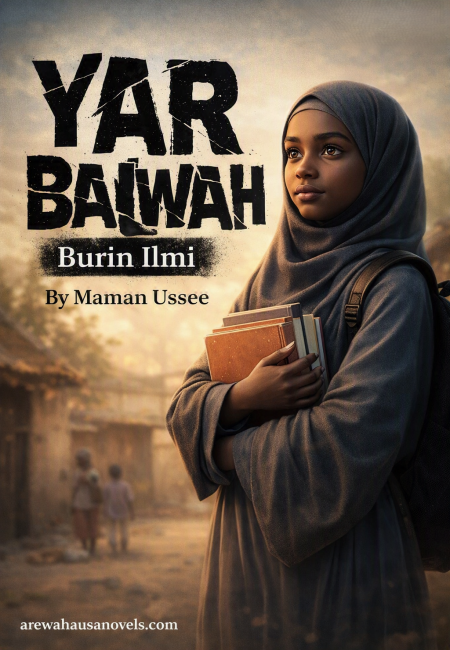
About this novel
YAR BAIWAH
Description
What happens when a gifted girl leaves the only home she has ever known and suddenly finds herself in a world she once knew only through imagination?
Rukayya, affectionately known as Yar Baiwah, grows up surrounded by love despite the simplicity of her life. She is quiet, intelligent, patient, respectful, and blessed with an extraordinary ability to understand whatever she is taught. But her greatest desire is not wealth or luxury. She wants education. She wants to see beyond the limits of her circumstances and become someone who can one day help her parents.
When an unexpected opportunity takes her from Raba to Sokoto, Rukayya enters a completely different world. New surroundings, a new family, a new school, unfamiliar customs, and a future she cannot yet predict await her. But the real question is not whether she can adapt to the city. It is whether the little girl everyone calls Yar Baiwah is destined for something far greater than anyone around her realizes.
Summary
Rukayya's story begins with a family that has endured years of waiting before finally receiving the blessing they prayed for. Her parents, Malan Sa'idu and Salame, waited ten years after marriage before Allah blessed them with a child. When Rukayya is born, she becomes the center of affection within the family. Her calm nature, patience, intelligence, and good manners quickly distinguish her from other children. She is loved deeply by her grandmother and everyone who watches her grow.
As Rukayya grows older, her intelligence becomes increasingly obvious. She has an exceptional memory and learns quickly, making education one of the greatest passions of her young life. Her circumstances, however, are modest. She comes from a family that does not have the financial comfort enjoyed by many others. Yet poverty does not weaken her ambition. Instead, it strengthens her determination to acquire knowledge and eventually use it to improve the lives of those who raised her.
Her life changes when she is given the opportunity to travel to Sokoto and stay with a family who welcomes her as one of their own. The journey itself becomes a turning point. For a girl accustomed to life in Raba, the city appears almost unbelievable. The beautiful house, unfamiliar conveniences, spacious rooms, school environment, and new lifestyle leave her fascinated. What once seemed like another world is suddenly the world in which she must learn to live.
At first, Rukayya is understandably shy and uncertain. She does not immediately understand everything around her, but she is surrounded by people who gradually help her find her footing. Sajeeda becomes particularly important to her, treating her like a genuine sister rather than a stranger. Their friendship develops into one of the strongest relationships in the story. Together they attend Islamic school, study, complete assignments, share laughter, and eventually become almost inseparable. Rukayya also receives encouragement from her new family, especially Daddy, who makes a deliberate effort to ensure that she receives the same opportunities as Sajeeda.
Soon, Rukayya's dream of attending formal school begins to come true. She is enrolled at Key Science Academy and placed in the same class as Sajeeda after successfully completing her entrance interview. Rather than allowing her unfamiliar background to hold her back, Rukayya quickly demonstrates the gift that earned her the name Yar Baiwah. Her academic performance begins attracting attention from teachers and fellow students. Her journey from a girl in Raba dreaming of education to a promising student in Sokoto becomes a powerful transformation, but her story is far from finished.
Genre
YAR BAIWAH is primarily a family, coming-of-age, inspirational, educational, and faith-centered Hausa drama. The story combines everyday family relationships with the emotional journey of a young girl discovering her abilities and finding new opportunities.
It is also a story about personal growth. Rather than relying solely on dramatic conflict, the novel develops its emotional impact through relationships, education, family sacrifices, friendship, cultural differences, and the gradual transformation of a young girl.
Setting
The story moves between Raba and Sokoto, creating an important contrast between two different environments.
Raba represents Rukayya's roots. It is the place where she grows up surrounded by her parents, grandmother, relatives, affection, simplicity, and the values that shape her character. It is also where her desire for education begins.
Sokoto represents opportunity and transformation. Once Rukayya arrives there, she encounters a more comfortable urban lifestyle, formal schooling, new relationships, and experiences that challenge her understanding of the world. The contrast between the two locations gives the story an additional layer because Rukayya does not simply travel from one place to another. She moves from one stage of her life into another.
Core Themes
The Power of Education
Education is one of the strongest forces driving Rukayya. She does not pursue knowledge merely for status. She wants to learn because she believes knowledge can eventually allow her to help her parents and build a better future.
Family and Sacrifice
The novel places strong emphasis on the meaning of family. Rukayya's parents endure hardship before having her, while her grandmother demonstrates deep affection and concern for her. Later, another family chooses to treat Rukayya with genuine care and provide opportunities that might otherwise have remained beyond her reach.
Friendship and Sisterhood
The relationship between Rukayya and Sajeeda becomes particularly meaningful. Their friendship develops beyond ordinary school companionship. They study together, laugh together, help one another, and protect each other's feelings. Their bond demonstrates how genuine affection can exist even when people are not connected by blood.
Faith and Gratitude
Faith remains woven into Rukayya's character and the decisions of the people around her. Prayer, Islamic education, gratitude, patience, and the belief that blessings come from Allah repeatedly influence the characters' outlook on life.
Humility Despite Talent
Rukayya possesses remarkable intelligence, but she does not become arrogant because of it. Her humility, respect, and willingness to learn make her talent even more admirable.
Kindness and Responsibility
The story also explores the value of helping others without expecting repayment. Rukayya's new family does more than give her a place to stay. They invest in her education and future, while recognizing the responsibility that comes with caring for another person's child.
Key Characters
Rukayya, Yar Baiwah: The central character. She is intelligent, patient, respectful, hardworking, and deeply interested in education. Her exceptional ability to learn quickly becomes one of the defining qualities of her character.
Malan Sa'idu: Rukayya's father. His journey with Salame reflects patience, family responsibility, and devotion. His daughter is a source of enormous happiness and pride to him.
Salame: Rukayya's mother, whose long wait for a child makes Rukayya's arrival especially precious. Her love and attachment to her daughter are central to Rukayya's early life.
Baaba: Rukayya's grandmother, whose affection for her granddaughter is unmistakable. She worries about Rukayya after her departure and continually remembers her in her prayers.
Daddy: A major influence after Rukayya moves to Sokoto. He takes responsibility for her education and treats her with the same care he gives his own children. His decision to provide her with schooling becomes one of the most important turning points in her life.
Mummy: A warm maternal presence in Rukayya's new environment. She helps Rukayya adjust to the household and includes her in everyday family life.
Sajeeda: Rukayya's closest friend and sister-like companion. Her friendship becomes one of the emotional anchors of Rukayya's new life.
Fadil and Abdallah: Younger members of the family who quickly accept Rukayya as their sister, contributing to the sense that she truly belongs in the household.
Hajiya Kareema: A more difficult presence in Rukayya's early experience in Sokoto. Her attitude toward Rukayya introduces tension and shows that not everyone immediately welcomes the girl's presence.
Alhaji Basheer and Hajiya Kubra: Another wealthy family introduced later in the story. Alhaji Basheer is presented as generous and respectful toward people, while Hajiya Kubra is portrayed as proud and dismissive, creating an interesting contrast in character and values.
Analytics and Insight
The strongest element of YAR BAIWAH is its portrayal of transformation through opportunity. Rukayya does not suddenly become gifted when she reaches Sokoto. Her ability has always been there. What changes is the environment around her. Once she receives access to better educational opportunities, her natural intelligence becomes increasingly visible.
The novel also presents an important contrast between wealth and worth. Rukayya comes from a modest background, while the family she joins in Sokoto enjoys a much more comfortable lifestyle. Yet the story does not suggest that money is what makes Rukayya valuable. Her character, intelligence, manners, faith, and determination give her a value that cannot be measured by material possessions.
Another important insight is the role of people who choose to invest in someone else's future. Daddy's decision to educate Rukayya demonstrates how one person's generosity can completely redirect another person's life. His support gives her access to opportunities she might not otherwise have received.
The story also emphasizes that a person's origin does not have to determine their destination. Rukayya begins as a young girl from Raba with a simple dream of learning English and gaining knowledge. Before long, she is attending a formal school, performing strongly, participating in academic activities, and earning recognition from teachers and fellow students.
Perhaps most importantly, the novel asks readers to consider what true family means. Rukayya's experience suggests that family is not defined only by blood. Sometimes family is found in the people who protect, educate, encourage, and love someone as though they were their own.
Why Readers Will Connect With It
Readers who enjoy Hausa stories about family, education, friendship, personal growth, faith, village-to-city transitions, and inspiring young characters are likely to find Rukayya's journey especially engaging.
Her story is appealing because she is not presented as someone who starts with everything. She starts with a dream. Her journey shows what can happen when intelligence meets opportunity, when determination meets support, and when a young person's potential is recognized instead of ignored.
But beneath the warmth and happiness is an important sense of anticipation. Rukayya's world is expanding rapidly, and every new environment introduces new people, new expectations, and new possibilities. Her journey is therefore not simply about getting an education. It is about discovering who she can become.
A Quote From the Story
“Her dream was simple: to gain knowledge so she could one day use it to help her parents.”
Final Insight
YAR BAIWAH is ultimately a story about a young girl whose greatest wealth is not what she owns, but what she carries within her. Rukayya's intelligence, humility, patience, faith, and hunger for knowledge set her apart from the beginning. Her journey from Raba to Sokoto opens a door that could change the direction of her entire life.
Yet the most intriguing part is that her journey has only begun. The girl once known simply as Yar Baiwah is entering a world where her abilities will be tested, her relationships will deepen, and her future will become increasingly difficult to predict.
Her greatest gift may have given her the name Yar Baiwah, but what she does with that gift may determine the person she eventually becomes.