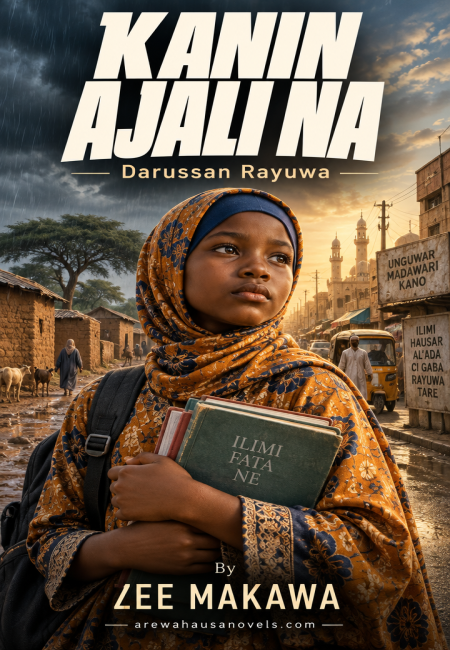
About this novel
KANIN AJALI NA
The Intrigue
Hadiza grows up in a home where love, family, poverty, pride, and cruelty exist under the same roof. As a young girl, she watches her mother endure the harsh treatment of her grandmother while trying to protect her children and preserve peace in a difficult household. What begins as the innocent story of a village girl gradually becomes a much deeper journey through family conflict, education, migration, ambition, marriage, and the complicated meaning of loyalty.
When Hadiza's family leaves the village for the city, she discovers a world far different from the one she knew. School opens new possibilities, her mother's life begins to change, and relatives who once seemed distant begin to take unexpected paths. Yet leaving the village does not mean leaving its problems behind. Old grudges, family expectations, and unresolved wounds continue to follow them.
And somewhere between childhood innocence and the realities of growing up, Hadiza begins to understand that the people closest to her can sometimes shape her life in ways she never expected.
Summary
Kan Kanin Ajali Na follows the early life of Hadiza, a young village girl whose childhood is filled with curiosity, affection, fear, family tension, and a deep attachment to her mother. The story opens during the rainy season, when Hadiza waits impatiently for her mother to return from the city. Her excitement over a new dress brought as a gift quickly exposes the innocence of her young age, but her joy is constantly interrupted by the strictness of her grandfather and the difficult atmosphere inside her extended family home.
At the center of Hadiza's childhood is her relationship with her mother, Saude, a hardworking woman who quietly carries the burdens of marriage and motherhood. Saude lives under the authority of Umma Hauwa, a grandmother whose sharp tongue, suspicion, and constant criticism make everyday life difficult. Hadiza watches her mother endure humiliation over food, household responsibilities, money, and even the care of her children. Although she is still young, Hadiza gradually becomes aware that her mother's silence is not weakness. It is often the only way she can survive the environment surrounding her.
The family's circumstances begin to change when Hadiza's father secures work in the city and eventually moves his family from their rural home to Kano. For Hadiza and her younger sister Shamsiya, the move represents a completely new beginning. She discovers a more developed environment, enters a better school, and becomes increasingly determined to learn. Her mother also begins studying in an Islamic school and slowly adapts to city life. Yet their new environment does not erase the emotional wounds of the past. Family disagreements continue, particularly when Hadiza's father struggles with his responsibilities toward his relatives.
One of the most important relationships in Hadiza's life is with her uncle Kabiru. Unlike the strained relationship between some members of the family, Kabiru shows genuine affection toward Hadiza and her siblings. His visits bring happiness into their home, and his success later becomes a source of pride for the family. His journey from struggling relative to a man involved in politics and public life also introduces Hadiza to another reality: people's circumstances can change dramatically, but those changes can also reshape family relationships.
As Hadiza grows older, she begins to see the world through more mature eyes. Her return to the village during Sallah exposes her to the excitement, expectations, gossip, and social pressures surrounding young girls. People notice her changing appearance, her education, and the differences between her city life and the life she once knew. Even seemingly harmless conversations begin to carry new meanings. The story therefore moves beyond Hadiza's childhood adventures and begins preparing her for the complicated realities of growing up in a society where family reputation, marriage, education, and tradition can strongly influence a young woman's future.
Novel Description
Kan Kanin Ajali Na is a Hausa family drama and coming-of-age story with elements of domestic conflict, rural and urban life, social commentary, family relationships, education, and emotional suspense. Rather than presenting Hadiza's life as a simple journey from childhood to adulthood, the narrative places her inside a complicated family structure where every relationship has its own history and every household decision can create another conflict.
The rural setting gives the early chapters a strong sense of community. Extended family members live close to one another, relatives share resources, children move between different parts of the compound, and news travels quickly through the village. The atmosphere is contrasted with the city, particularly Kano, where Hadiza encounters formal schooling, a different lifestyle, modern household facilities, and a wider social environment.
The movement between village and city is important because it mirrors Hadiza's personal development. The village represents her childhood, family roots, tradition, and the painful experiences that shape her understanding of people. The city represents opportunity, education, transformation, and independence, but it also introduces new challenges that Hadiza and her family must learn to navigate.
Core Themes
Family and Sacrifice
At the heart of the story is the complicated meaning of family. Blood relationships do not always guarantee kindness, and disagreements can exist even among people who live under the same roof. Through Saude, the story explores the sacrifices a mother makes for her children while trying to maintain peace within a difficult extended family.
The Struggles of a Woman
Saude's experiences reveal the pressures placed upon women within marriage and extended-family structures. She works, raises children, manages the household, tolerates criticism, and still tries to ensure that her daughters receive opportunities she herself never had.
Education and Opportunity
Hadiza's love for school becomes one of the clearest signs of her determination. Her mother understands the importance of education because she personally missed the opportunity to receive modern schooling. Their move to the city therefore becomes more than a change of location. It becomes a chance for the next generation to build a different future.
Childhood Innocence
Hadiza often reacts to events with the honesty and impulsiveness of a child. Her excitement over clothes, food, visitors, school, relatives, and gifts creates moments of warmth, but her innocence also places her in situations where she does not fully understand the seriousness of adult conflicts.
Tradition and Change
The novel constantly places traditional rural life beside the changing world of the city. Characters must negotiate between established family expectations and new opportunities brought by education, employment, migration, and social change.
Family Loyalty and Resentment
The relationship between Hadiza's father and his brother Kabiru demonstrates how quickly family loyalty can become complicated. Past support, disappointment, pride, and personal ambition all influence how relatives treat one another.
Key Characters
Hadiza is the central young character and the eyes through which much of the story unfolds. Curious, emotional, outspoken, and eager to learn, she observes the adults around her while gradually developing her own understanding of family and society. Her innocence makes her experiences particularly revealing because she often notices emotional truths before she fully understands them.
Saude, Hadiza's mother, is a hardworking and patient woman who carries significant responsibility for her children. She lives under constant criticism from Umma Hauwa but continues caring for her family with determination. Her desire to see her children educated becomes one of the strongest motivations in the story.
Umma Hauwa is one of the most influential figures in Hadiza's childhood. Strict, argumentative, suspicious, and highly controlling, she frequently clashes with Saude and other members of the family. Her behavior creates much of the household tension and gives Hadiza an early understanding of how power can operate within a family.
Hadiza's Father is a hardworking man whose employment takes him away from home for long periods. His decisions eventually lead the family from the village to the city. However, his relationship with his relatives, especially Kabiru, becomes complicated by his strong personality and difficult decisions.
Baba Kabiru stands out as someone who shows affection toward Hadiza and her family. His willingness to help them contrasts with some of the family's internal conflicts. His later success in politics and public life adds another dimension to his character and changes how other relatives perceive him.
Shamsiya, Hadiza's younger sister, is still very young during the events described. Her illness becomes a source of anxiety for the family and reveals both Saude's determination and the tensions surrounding the family's access to care and financial resources.
Analytics & Insight
The strongest element of Kan Kanin Ajali Na is its portrayal of ordinary family life from the perspective of a child growing into awareness. The story does not rely solely on dramatic events. Much of its emotional power comes from everyday experiences: food being shared or withheld, children being sent on errands, relatives arriving with gifts, arguments over household responsibilities, school attendance, visits from family members, and the excitement surrounding a return to the village.
Hadiza's perspective also gives the narrative an important emotional quality. She does not initially understand every adult disagreement, but she feels its consequences. She notices when her mother cries. She notices when her father is angry. She notices when Kabiru treats her kindly. She notices how differently Umma treats different grandchildren. These observations gradually become part of her education, perhaps even more important than what she learns in school.
The contrast between Saude and Umma is another major source of tension. One woman attempts to preserve peace through patience, while the other frequently asserts authority through confrontation. Their conflict creates a household where even simple events can become emotionally charged.
The novel also raises an important question about generational change. Hadiza's mother did not receive the education she wanted, but she is determined that her children should have opportunities that were denied to her. That desire becomes one of the most meaningful threads running through the story.
A Quote to Capture the Story
"Hadiza was still a child, but the house was already teaching her lessons that no classroom could contain."
This line captures the emotional foundation of the novel. Hadiza's education does not come only from school. It comes from watching her mother endure hardship, seeing relatives disagree, experiencing the difference between village and city life, and slowly discovering that growing up means learning truths that childhood cannot always explain.
What Makes the Story Compelling?
Kan Kanin Ajali Na draws readers into the intimate world of an extended Hausa family and allows them to experience that world through the eyes of a young girl. The story combines humor, innocence, family tension, emotional moments, social expectations, and the uncertainty of growing up.
What begins with a child waiting excitedly for her mother to return gradually opens into a much larger story about identity, family, education, migration, ambition, and the invisible struggles that women and children can carry within a household.
Hadiza's journey is only beginning, and the experiences of her childhood are already laying the foundation for the person she will eventually become. The deeper question is not simply what will happen to her, but how everything she witnesses will shape the choices she makes when childhood is no longer enough to protect her from the realities of life.